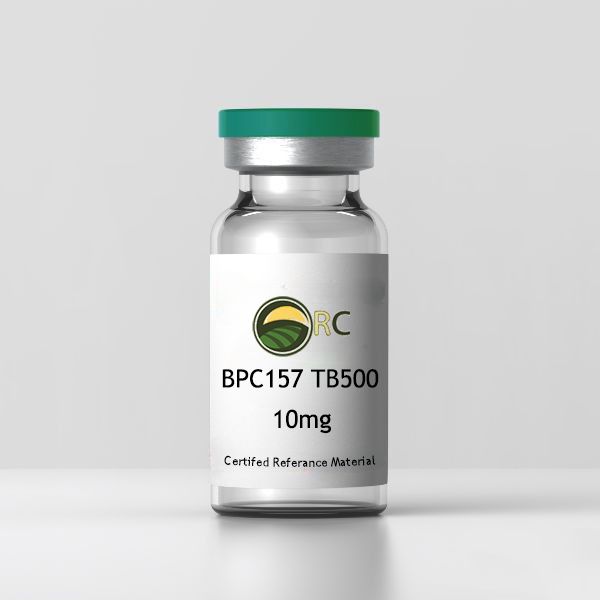
Description
Synergistic Dual-Peptide Blend: BPC157 + TB500
The BPC157 + TB500 combination represents a cornerstone formulation in modern biochemical and bio-matrix research. By pairing a synthetic 15-amino-acid derivative of body protection compound (BPC-157) with full-length Thymosin Beta-4 (TB-500/TB4), this dual-peptide blend enables researchers to analyze multi-pathway tissue remodeling, cellular migration, and extracellular matrix stabilization within a single experimental system.
Technical & Product Specifications
-
Blend Ratio / Size: 10mg Total Vial (5mg BPC-157 / 5mg TB-500 TB4)
-
Overall Purity: >99% (HPLC Verified)
-
Storage Condition: Store at -20℃ (Stable up to 3 years)
BPC-157 Component Specifications:
-
CAS No.: 137525-51-0
-
Molecular Weight (M.Wt): 1419.5 g/mol
TB-500 (Thymosin $\beta$4) Component Specifications:
-
CAS No.: 77591-33-4
-
Molecular Formula: $\text{C}_{212}\text{H}_{350}\text{N}_{56}\text{O}_{78}\text{S}$
-
Molecular Weight (M.Wt): 4921 g/mol
Complementary Research Mechanisms
Combining these two distinct peptide structures allows researchers to examine concurrent signaling pathways in cell culture and tissue repair models:
-
Cytoskeletal Remodeling & G-Actin Dynamics: TB-500 acts as an primary actin-sequestering peptide. It binds G-actin to promote cell motility, dermal keratinocyte migration, and focal adhesion assembly at wound margins.
-
Angiogenesis & Nitric Oxide Expression: BPC-157 works alongside cellular migration by upregulating VEGFR2 pathways and nitric oxide signaling, facilitating new microvascular network formation to nourish regenerating tissues.
-
Fibroblast & Extracellular Matrix Support: Together, the bpc157+tb500 blend modulates collagen deposition and fibroblast proliferation, reducing scar tissue formation in tendon, muscle, and ligament assays.
Laboratory Sourcing & Protocol Optimization
Determining proper bpc157+tb500 dosage parameters depends strictly on the specific cell line, assay structure, and tissue target being investigated. In complex anti-inflammatory or GI tract research models, investigators may also evaluate a tri-blend formula like bpc157+tb500+kpv to assess the additional anti-inflammatory contributions of alpha-MSH fragments.
When sourcing a bpc157+tb500 peptide complex for quantitative analytical research, maintaining verified >99% sequence purity guarantees baseline consistency, minimal baseline noise, and high trial-to-trial reproducibility.
High-Purity Research Compounds
Receptor Chemicals provides analytical-grade research compounds engineered to meet rigorous scientific standards. Every lot undergoes stringent quality control testing to confirm mass spectrometry verification, chemical stability, and structural integrity across bioenergetic and cellular research workflows.