Cart 0 items for £0.00

KLOW (BPC, TB500, KPV, GHKCU)

KLOW (BPC, TB500, KPV, GHKCU)

Product Information

£89.99

Multi-Pathway Regenerative Chemistry: KLOW (BPC, TB500, KPV, GHKCU)

KLOW (BPC, TB500, KPV, GHKCU) represents a composite research formulation engineered to target complementary physiological repair mechanisms. By combining four distinct active compounds—GHK-Cu (copper tripeptide), TB-500 (thymosin beta-4 fragment), BPC-157 (body protection compound pentadecapeptide), and KPV (alpha-MSH-derived tripeptide)—this composite solution allows laboratory investigators to study cellular regeneration, angiogenesis, extracellular matrix remodeling, and inflammatory cascades in a single, unified matrix.

Technical & Product Specifications

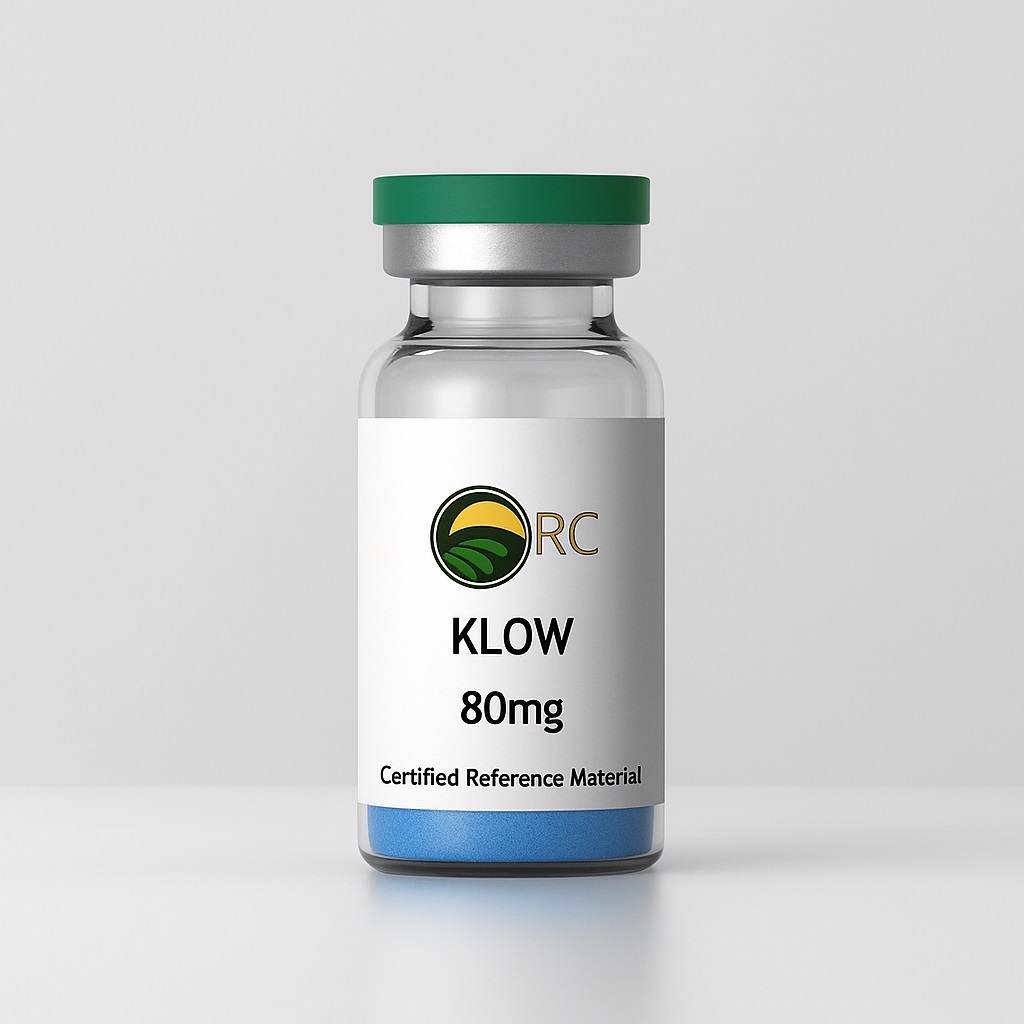
  • Total Content: 80mg Lyophilized Composite

  • Component Distribution: BPC-157 (10mg), TB-500 / TB4 (10mg), GHK-Cu (50mg), KPV (10mg)

  • Purity: >99% per component (HPLC verified)

  • Form: Lyophilized Powder (Light Blue Tint due to bound copper)

  • Solubility: $\text{H}_2\text{O}$

  • Storage: Store at -20°C (up to 3 years)

Quad-Action Signaling Mechanics

Each constituent in the klow blend peptide targets a distinct molecular pathway:

  • GHK-Cu (Extracellular Matrix Remodeling): Regulates collagen synthesis, gene expression, and fibroblast activation while transporting essential copper ions.

  • TB-500 (Cell Migration & Actin Regulation): Promotes endothelial cell movement, tissue closure, and microvascular sprouting via actin-G sequestration.

  • BPC-157 (Vascular Integrity & Soft Tissue Repair): Activates VEGFR2 pathways to support angiogenesis and soft tissue repair models.

  • KPV (Targeted Inflammatory Regulation): Downregulates NF-$\kappa$B activation to reduce pro-inflammatory cytokine output without triggering melanocortin pigmentation pathways.

Building upon traditional triple-blend research options, adding KPV introduces direct nuclear factor kappa B (NF-$\kappa$B) modulation, giving researchers a comprehensive model for investigating chronic inflammatory environments alongside structural recovery.

Laboratory Assays & Concentration Guidance

When evaluating experimental parameters, determining precise klow peptide dosage concentrations requires accounting for the proportional mass distribution within the 80mg lyophilized vial. Because GHK-Cu constitutes 62.5% of the total mass, serial dilution protocols must calculate individual molarity for each compound to maintain reproducible conditions in multi-well cell cultures.

Analytical research facilities investigating klow peptides demand high chromatographic purity to avoid non-specific binding artifacts during receptor binding assays and cellular uptake trials. Utilizing single-vial composite formulations streamlines laboratory protocols, reducing volumetric errors associated with mixing separate compounds.

Premium Reagents by Receptor Chemicals

Receptor Chemicals provides analytical-grade compounds engineered to satisfy rigorous scientific standards. Every batch of our klow peptide inventory undergoes HPLC and Mass Spectrometry validation to ensure structural identity, exact mass ratio accuracy, and total freedom from unreacted impurities.
Description

Multi-Pathway Regenerative Chemistry: KLOW (BPC, TB500, KPV, GHKCU)

KLOW (BPC, TB500, KPV, GHKCU) represents a composite research formulation engineered to target complementary physiological repair mechanisms. By combining four distinct active compounds—GHK-Cu (copper tripeptide), TB-500 (thymosin beta-4 fragment), BPC-157 (body protection compound pentadecapeptide), and KPV (alpha-MSH-derived tripeptide)—this composite solution allows laboratory investigators to study cellular regeneration, angiogenesis, extracellular matrix remodeling, and inflammatory cascades in a single, unified matrix.

Technical & Product Specifications

  • Total Content: 80mg Lyophilized Composite

  • Component Distribution: BPC-157 (10mg), TB-500 / TB4 (10mg), GHK-Cu (50mg), KPV (10mg)

  • Purity: >99% per component (HPLC verified)

  • Form: Lyophilized Powder (Light Blue Tint due to bound copper)

  • Solubility: $\text{H}_2\text{O}$

  • Storage: Store at -20°C (up to 3 years)

Quad-Action Signaling Mechanics

Each constituent in the klow blend peptide targets a distinct molecular pathway:

  • GHK-Cu (Extracellular Matrix Remodeling): Regulates collagen synthesis, gene expression, and fibroblast activation while transporting essential copper ions.

  • TB-500 (Cell Migration & Actin Regulation): Promotes endothelial cell movement, tissue closure, and microvascular sprouting via actin-G sequestration.

  • BPC-157 (Vascular Integrity & Soft Tissue Repair): Activates VEGFR2 pathways to support angiogenesis and soft tissue repair models.

  • KPV (Targeted Inflammatory Regulation): Downregulates NF-$\kappa$B activation to reduce pro-inflammatory cytokine output without triggering melanocortin pigmentation pathways.

Building upon traditional triple-blend research options, adding KPV introduces direct nuclear factor kappa B (NF-$\kappa$B) modulation, giving researchers a comprehensive model for investigating chronic inflammatory environments alongside structural recovery.

Laboratory Assays & Concentration Guidance

When evaluating experimental parameters, determining precise klow peptide dosage concentrations requires accounting for the proportional mass distribution within the 80mg lyophilized vial. Because GHK-Cu constitutes 62.5% of the total mass, serial dilution protocols must calculate individual molarity for each compound to maintain reproducible conditions in multi-well cell cultures.

Analytical research facilities investigating klow peptides demand high chromatographic purity to avoid non-specific binding artifacts during receptor binding assays and cellular uptake trials. Utilizing single-vial composite formulations streamlines laboratory protocols, reducing volumetric errors associated with mixing separate compounds.

Premium Reagents by Receptor Chemicals

Receptor Chemicals provides analytical-grade compounds engineered to satisfy rigorous scientific standards. Every batch of our klow peptide inventory undergoes HPLC and Mass Spectrometry validation to ensure structural identity, exact mass ratio accuracy, and total freedom from unreacted impurities.
Related Products